Abstract
This article provides a structural analysis of how motorcycle clubs (MCs) organise authority, distribute function, and regulate membership progression. It examines the formal hierarchy of officer roles, the staged membership model, and the relationship between local chapters and wider club structures.
The article defines motorcycle club structure through its constituent components – elected governance, codified roles, tiered membership, and inter-chapter authority- and analyses how these elements function as an integrated organisational system.
This work does not address legal classification, criminality, or advocacy. It is limited to organisational and cultural structure as documented through academic research, ethnographic study, and first-hand cultural record.
This article forms part of a broader structured record documenting motorcycle club culture through consistent terminology, methodology, and classification.
Keywords: motorcycle club structure, motorcycle club hierarchy, officer roles, membership progression, chapter structure, MC governance, prospect protocol, full patch, biker studies
Category: Cultural Frameworks
Author: Belinda Sharland | Strengthening The Set
Context & Scope
Geographic Scope: Primarily UK-informed, with reference to broadly recognised motorcycle club structures internationally where consistent.
Type of Clubs Covered: Motorcycle clubs operating within MC culture, using MC protocol. Includes 1% and non-1% MCs where structural features are consistent.
Excluded:
- Informal riding groups
- Legal classifications or enforcement frameworks
- Behavioural or criminal characterisations
- Club-specific internal rules not subject to cross-club documentation
The Definition
This record adopts the following definition:
The structure of a motorcycle club (MC) is the organised system through which authority is distributed, membership is regulated, and club function is maintained. It consists of elected officer roles operating within a formal hierarchy, a tiered membership progression governing entry and standing, and a chapter or charter framework through which local units relate to wider club authority. Structure is not incidental to MC identity – it is constitutive of it.
Methodological Position
- Academic literature review (Dulaney, von Lampe & Blokland, Forsyth & Quinn, Conti, Hopper & Moore)
- Structural analysis of motorcycle club governance and membership systems
- Comparative analysis of recurring MC terminology and organisational frameworks
- Ethnographic observation studies
- First-hand cultural documentation
- Cultural systems framing
- Analysis of protocol, hierarchy, and inter-club authority structures
The Documentation Gap
Public accounts of motorcycle club structure frequently default to law enforcement categorisation or media representation. These framings describe MC hierarchy as criminal architecture rather than organisational governance. This has produced a body of public record that misidentifies the function of officer roles, distorts the membership process, and removes cultural context from structural features that have documented parallels in other recognised fraternal and voluntary organisations.
Academic research has consistently found that MC governance operates through democratic election, formal meeting procedure, and collective decision-making, findings that rarely reach public discourse.
Core Explanation (System-Level)
Structural Overview
A motorcycle club operates through three interconnected structural layers: an elected officer hierarchy that governs the club through a collective executive structure, a tiered membership progression that regulates entry and standing through collective approval, and an organisational framework, either chapter or charter based, that determines how the club expands geographically and where authority sits within that expansion. These layers are interdependent. Authority flows through all three simultaneously, but the nature of that authority differs significantly depending on the club’s structure and organisational model.
Components
Officer Hierarchy: Elected roles with defined functions, democratic accountability, and collective authority. The executive committee is the governing body through which officer authority is exercised. Officer titles vary between clubs; function is more consistent than terminology.
Membership Tiers: Staged progression from initial association to full standing, controlled by collective approval at every stage. Progression is non-automatic and cannot be self-claimed.
Chapter and Charter Framework: Local organisational units operating within the wider club structure. The model adopted, chapter or charter, determines the nature of the relationship between local units and wider club authority. Not all clubs operate through either model.
Protocol System: Codified rules governing conduct, decision-making, and inter-club relations. It is noted that the application of protocol varies significantly across clubs and regions. In practice, some clubs treat protocol as binding standard while others apply it selectively. This variation is itself a documented feature of contemporary MC culture rather than a deviation from it.
Inter-Club Authority: Recognition systems that regulate legitimacy across clubs and chapters.
Relationships
- Officer authority is conferred through election, not appointment
- Membership progression is controlled by governance approval at each stage
- Chapter and charter autonomy operates within the bounds of club-wide authority, dependent on organisational model
- Protocol governs both internal conduct and external recognition
- Inter-club authority determines legitimacy beyond the individual chapter
Function
This structure functions to:
- Regulate entry and belonging through collective decision-making
- Distribute authority across defined roles with specific functions
- Maintain internal order, continuity, and institutional identity
- Enable the club to operate consistently across geography and time
Chapter and Charter Framework; A Critical Distinction
Public accounts of MC organisational structure frequently use the term chapter as a catch-all for any local unit of a club. This is inaccurate. Within MC culture, chapters and charters are structurally distinct and the difference is operationally significant.
Chapters
Clubs that operate through a chapter structure typically have a national mother chapter, the founding unit and highest authority within the club’s structure. As the club expands geographically, new chapters are established in different areas. These chapters operate under the club’s name and colours and are generally expected to follow the direction and authority of the national mother chapter. The mother chapter sets the standard, holds ultimate institutional authority, and the relationship between chapters and the mother chapter reflects a defined hierarchy of governance.
Charters
Clubs that operate through a charter model function differently. A charter is granted to a group operating under the wider club’s name and identity, but charters tend to govern themselves independently. They hold their own authority over their direction, decisions, and internal governance. While they operate as part of the larger club and carry its identity, they are not subject to the same directional authority that chapters receive from a mother chapter. A charter’s relationship to the wider club is one of affiliation and shared identity rather than hierarchical governance.
The distinction matters because it affects where authority sits, how decisions are made, and what obligations a local unit carries to the wider club structure. Conflating chapters and charters misrepresents both models and produces an inaccurate account of how MC organisational authority actually operates.
It is also worth noting that not all clubs operate through chapters or charters. Smaller clubs, or clubs operating within a single geographic area, function as a single unit without the need for an expanded organisational framework.
Process / Mechanics
Officer Roles and Functions
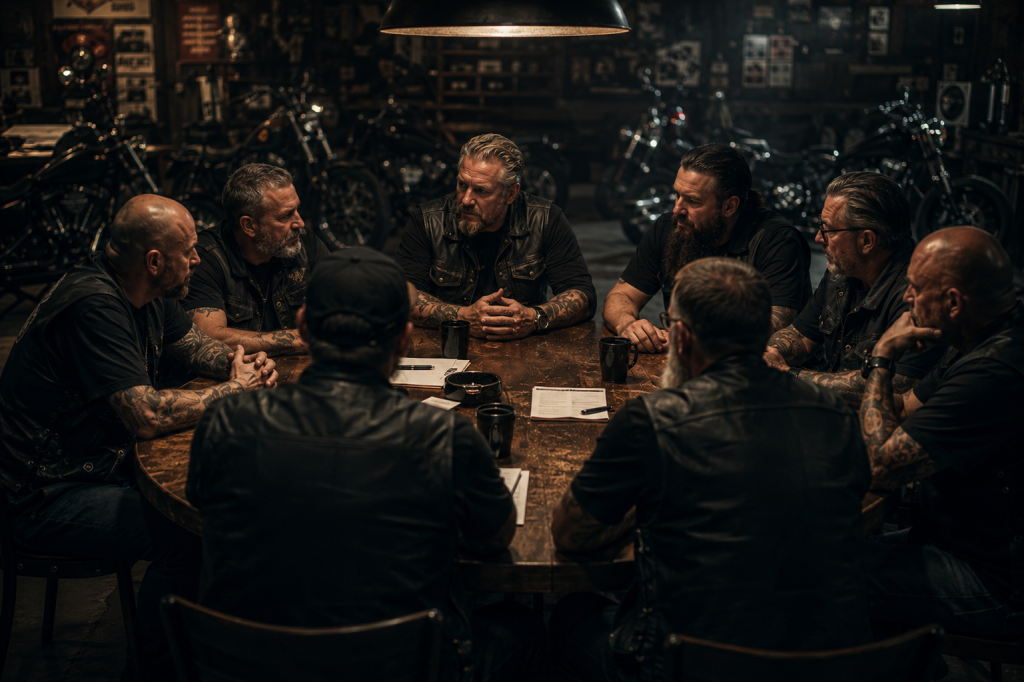
Motorcycle clubs are governed by an executive committee made up of elected officers. The roles most commonly documented across MC culture include President, Vice President, Sergeant at Arms, Secretary, Treasurer, and Road Captain. However, this list is not universal. In practice, officer structures vary between clubs, some clubs operate with fewer roles, some with additional positions, and some with titles that differ, while the function remains consistent.
In smaller clubs, the Sergeant at Arms will often perform the functions typically associated with a Vice President, absorbing both roles within a leaner executive structure. Additional role variations exist but are less common; a club may, for example, carry a Safety Officer performing Vice President functions; however, these are rare and club-specific rather than structurally consistent across MC culture. What remains consistent is not the title but the function: clubs govern themselves through a defined executive structure in which roles carry specific responsibilities and accountability to the membership.
Two positions within that structure require particular attention.
President The President is the ultimate authority within the officer circle. The President chairs church, the formal club meeting, and represents the club in external relations. That authority derives from and remains accountable to the membership through democratic election. The President holds final authority on club decisions.
Sergeant at Arms The primary function of the Sergeant at Arms is the protection of the President. This is the role’s foundational responsibility and the basis from which all other functions extend. The Sergeant enforces club rules and internal discipline, maintains security at club events and runs, and carries a role that extends significantly beyond what the title suggests to those outside MC culture. The full scope of the Sergeant at Arms role is complex and documented extensively in its own right – it is not reducible to a simple enforcement function. Some clubs separate the enforcement and security functions across two distinct roles. Others consolidate them entirely under the Sergeant. Both are legitimate structural variations. In smaller clubs, the Sergeant at Arms will frequently absorb Vice President functions within the executive structure.
It is also worth noting that larger clubs do not operate with a single Sergeant at Arms. As membership numbers grow, the club determines how many Sergeants it needs to fulfil the role effectively. The number of Sergeants at Arms in active function at any given time is therefore a reflection of club size and membership need rather than a fixed structural constant. This is a club-governed decision, not a deviation from protocol.
Vice President Deputises for the President and typically manages internal club operations. Functions as a bridge between the officer structure and the general membership.
Secretary maintains meeting minutes, manages club correspondence, tracks committee work and ongoing business. Dulaney’s research identifies this as one of the most functionally significant officer roles – consistently underrepresented in public accounts of MC organisation.
Treasurer Manages club dues, collective funds, and financial obligations. Directly accountable to the full membership.
Road Captain Plans and leads organised runs. Responsible for rider safety and logistical coordination on the road. A role specific to MC culture with no direct equivalent in most other organisational frameworks. Notably, while the Road Captain holds a position on the executive committee, this role does not carry a committee vote. The Road Captain’s authority is operational rather than governance-based.
Full Patch Members The collective voting body of the club. All major decisions, including officer elections and membership approvals, pass through the full membership. Authority within an MC is ultimately collective, not individual.
Membership Progression
Entry into an MC is staged, controlled, and non-automatic. Each stage requires collective approval before progression.
Hangaround: The initial association stage. A hangaround is present in club spaces and interacts with members but holds no formal standing. They are not members, do not wear club identifiers, and do not vote. This is an observation and evaluation stage, mutual and bilateral.
Prospect A formally acknowledged candidate for membership. The prospect period varies in length between clubs and is assessed on readiness rather than time served, spanning from several months to, in documented cases, as long as fifteen years. Prospects may wear limited club identifiers, commonly the bottom rocker only. Whether a prospect attends church is determined by club by-law; it is more common for prospects not to attend. This stage functions both practically, as an evaluation period, and symbolically, as a transition from civilian identity toward club identity.
Prospect and probate are distinct statuses and must not be conflated. A prospect has never held full membership and is progressing toward it. A probate is a former full patch member whose patch has been pulled and who is subject to a club-governed reinstatement process. These are two structurally separate positions within MC membership structure.
Full Patch Member Full membership is granted by a vote of the existing membership. In most clubs, this requires a unanimous vote. This standard is not incidental – prospects are typically informed of this requirement at the outset of their journey, and it shapes the entire prospecting period. A single dissenting vote is sufficient to prevent a patch-in under this model. The unanimity requirement reflects the weight MC culture places on collective trust as the basis for full membership. Upon patching in, the full three-piece patch is awarded. The member assumes full voting rights, full standing, and full obligations to the club.
Progression is controlled and non-automatic at every stage. It cannot be self-claimed.
Cultural Meaning
Within MC culture, this structure represents:
- Earned identity – membership is granted, not assumed. Standing must be demonstrated and approved
- Collective authority – no individual role operates outside the accountability of the membership
- Institutional continuity – structure enables the club to persist beyond any individual member or officer
- Legitimacy through process – recognition, both internal and inter-club, is conferred through established systems, not self-declaration
Motorcycle club structure is not bureaucracy for its own sake. It is the mechanism through which a motorcycle club maintains its integrity, its identity, and its continuity over time.
Variations & Differences
- Officer titles vary between clubs and regions – function is more consistent than terminology
- Prospect period length varies significantly between clubs and is assessed on readiness, not time served
- Voting thresholds for membership approval reflect club-specific standards – unanimous vote is the most commonly documented requirement
- Chapter and charter autonomy varies in degree across different club structures
- Historical continuity exists alongside adaptation to legal and social environments
- 1% and non-1% MCs share core structural features while differing in protocol specifics
- Not all clubs operate through chapter or charter frameworks
Evidence & Sources
Academic Sources
Dulaney, W.L. (2005) A brief history of “outlaw” motorcycle clubs. International Journal of Motorcycle Studies, 1(1). Available at: https://ijms.nova.edu/November2005/IJMS_Artcl.Dulaney.html (ijms.nova.edu in Bing) (Accessed: 4 June 2026).
Dulaney, W.L. (2006) Over the edge and into the abyss: The communication of organizational identity in an outlaw motorcycle club. PhD dissertation. Florida State University.
von Lampe, K. & Blokland, A. (2020) Outlaw motorcycle clubs and organized crime. ProHIC.
Forsyth, C.J. & Quinn, J.F. (2009) Leathers and Rolexs: The symbolism and values of the motorcycle club. Deviant Behavior, 30(3), pp. 235–265.
Conti, N. (n.d.) More like sons of conformity: Motorcycle clubs, moral careers, and normalization. Available at: https://www.academia.edu (Accessed: 4 June 2026).
Hopper, C.B. & Moore, J. (1990). Women in outlaw motorcycle gangs. Journal of Contemporary Ethnography, 18(4), pp. 363–387.
Primary Accounts
- Ethnographic observation studies
- First-hand cultural documentation
Limitations of Evidence
- Internal protocol is not uniformly documented across clubs
- Variations between clubs limit universal claims
- The majority of academic literature approaches motorcycle club structure through a criminological rather than cultural lens, requiring critical reading and reframing
Common Misconceptions
Misconception: MC officer roles function like positions in a criminal hierarchy Observation: Academic research documents democratic election, Robert’s Rules of Order, and collective accountability as the operative governance model. Officer authority derives from the membership, not from personal power.
Misconception: The prospect period is hazing. Observation: Academic literature documents the prospect stage as serving practical evaluation functions and symbolic identity transition – structurally comparable to probationary periods in other regulated organisations. In reality, the prospect period is a learning experience during which the candidate demonstrates readiness for full membership.
Misconception: Membership is informal or self-determined. Observation: Membership is granted through collective vote, regulated through staged progression, and revocable through the same governance structures that confer it.
Misconception: Prospect and probate are interchangeable terms for pre-membership candidates Observation: These are two structurally distinct statuses. A prospect has never held full membership and is progressing toward it. A probate is a former full patch member whose patch has been pulled and who is subject to a club-governed reinstatement process. Conflating the two misrepresents both the membership system and the significance of full patch status within MC culture.
Neutral Observations
The organisational structure of a motorcycle club shares documented parallels with other recognised hierarchical voluntary organisations. Academic literature has previously noted structural similarities between MC governance and military units and fraternal organisations. These parallels extend to specific operational details when examined closely.
The RAF Air Cadet organisation, for example, operates through a commanding officer executive structure responsible for governance and decision-making, a defined set of junior-ranked roles beneath it; Flight Sergeant, Sergeant, Corporal, and a tiered progression system in which advancement to higher standing, including First Class Cadet status, requires demonstrated competency assessed through both oral and written formal examination. The structural logic of earned rank, collective governance, and staged progression operating within a defined hierarchy is consistent across both systems.
This does not equate the two organisations in purpose, culture, or context. It demonstrates that the structural model through which motorcycle club culture operates is neither unusual nor unique to that culture. Hierarchical governance, earned progression, executive decision-making structures, and rank conferred through recognised process rather than self-appointment are features of numerous organisations that function without question within mainstream society.
The democratic and procedural nature of MC governance – elected officers, defined roles, collective decision-making authority – is consistently noted in academic literature but rarely reflected in public discourse. This gap between documented organisational reality and public perception is one of the central functions of this record.
Collective authority is a defining structural feature. Individual officer power, including that of the President as ultimate authority within the executive circle, is bounded by the membership accountability through which that authority was conferred and through which it can be withdrawn.
Membership progression systems within MC culture serve both organisational and identity functions, regulating who enters the club while marking the transition from civilian identity to club membership in a manner structurally comparable to rank progression in other assessed, hierarchical organisations.
Ethical Notes
- This article documents structure, not behaviour or legality
- No operational detail is included that could cause harm
- No endorsement or criticism of MC culture is implied
- Cultural practices are presented neutrally and respectfully
- Officer roles and membership processes are described in terms of function, not evaluation
RC 003 | Strengthening The Set | Kutte Kulture Ltd | Belinda Sharland | May 2026