
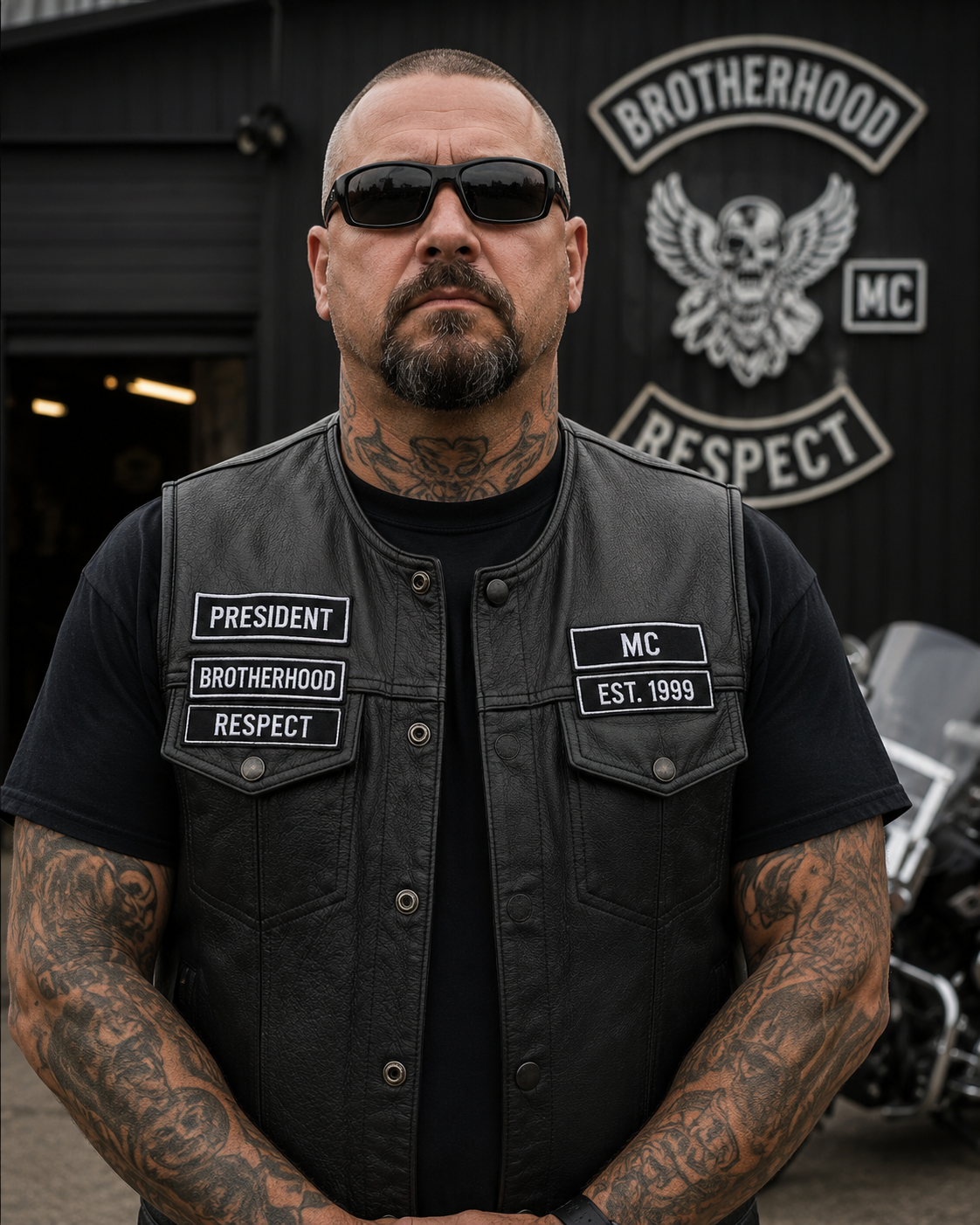
Definition
The President is often described as the leader and highest authority within the MC officer structure; however, that authority derives from the executive committee and the membership and remains accountable to both.
He functions as the principal executive officer and public representative of the club. Responsibilities include chairing meetings, directing executive activity, maintaining organisational direction, and acting as the primary point of contact for external organisations or individuals.
The President oversees overall club operations, chairs executive committee meetings, and maintains order during proceedings, often with assistance from the Sergeant-at-Arms.
In formal procedure, the President typically does not raise or second motions and does not vote unless required to determine the outcome (e.g., casting a deciding vote in the event of a tie).
Function Within MC Culture
The President role serves as the central point of leadership, coordination, and representation within the club structure.
Structurally, the position exists to:
- Provide unified direction and continuity in decision-making
- Ensure meetings and operations follow agreed protocol and governance standards
- Act as the official voice of the club in both internal and external matters
Culturally, the President contributes to:
- Maintaining order, discipline, and respect within meetings and club activities
- Upholding traditions, hierarchy, and established protocol
- Ensuring cohesion between officers, members, and chapters
The role reinforces organisational stability by balancing authority with accountability to the membership.
Common Features
- Chairs all official meetings and executive sessions
- Recognised as the senior officer within the club hierarchy
- Maintains order during meetings, often supported by the Sergeant-at-Arms
- Oversees and directs executive committee activity
- Acts as the primary external representative and contact
- Does not typically raise or second motions
- Votes only when necessary to affect the outcome (e.g., tie-breaking)
- Expected to attend all major meetings, runs, and official functions
- Sets tone for discipline, conduct, and adherence to protocol
- Provides leadership guidance to officers and members
Organisational Context
The President protocol applies across multiple levels of club function:
- Chapter Level: attends meetings and is the main contact and voice for the club.
- Club-Wide: May participate in or coordinate with national or international leadership structures depending on club size
- Inter-Club: Represents the club in interactions with other clubs, organisations, or alliances
- Public-Facing: Acts as official spokesperson when required
- Ceremonial: Leads or presides over formal events, memorials, and official gatherings
- Disciplinary: Oversees or participates in enforcement of club rules and internal governance processes
Variations & Interpretive Differences
Practices relating to the President role may vary significantly between clubs, regions, traditions, and organisational structures.
Differences may include:
- Degree of authority exercised independently versus collectively
- Voting practices and procedural involvement
- Level of involvement in day-to-day operations
- Relationship with other officers (e.g., Vice President, Sergeant-at-Arms)
These variations reflect the decentralised and autonomous nature of motorcycle club governance.
Misconceptions
Misconception: The President holds absolute authority over the club
Clarification: Authority is derived from and may be challenged by the membership and executive committee
Explanation: The President leads but remains accountable to the club’s governance structure
Misconception: The President actively participates in all motions and votes
Clarification: The President typically does not raise or second motions and only votes when necessary
Explanation: This maintains neutrality and reinforces procedural fairness during meetings
Misconception: The President operates independently of other officers
Clarification: The role functions as part of a coordinated executive structure
Explanation: Effective leadership depends on collaboration with other officers and adherence to protocol
Cultural & Historical Notes
The President’s role has evolved alongside the development of structured motorcycle club governance. While early clubs may have operated more informally, modern MCs typically adopt defined officer roles influenced by organisational governance, military structure, and longstanding club traditions.
Archive Notes
Due to the decentralised nature of Motorcycle Club culture, protocols are rarely universally standardised and may differ across organisations and jurisdictions.
Related Protocols
- Officer Authority
- Meeting Procedure
Related Glossary Terms
- Executive Committee
- Sergeant-at-Arms
- Vice President
Sources / References
Rostami, A., Mondani, H., Liljeros, F. & Edling, C. (2017) ‘Criminal organizing: applying the theory of partial organization to four cases of organized crime’, Trends in Organized Crime, published online 1 July. Available at: https://link.springer.com/content/pdf/10.1007/s12117-017-9315-6.pdf
Dulaney, W.L. (2006) Over the edge and into the abyss: The communication of organizational identity in an outlaw motorcycle club. Available at: http://purl.flvc.org/fsu/fd/FSU_migr_etd-0642 (Accessed 5 June 2026).
Comparative analysis of recurring organizational frameworks
Ethnographic Observation studies
First hand cultural documentation